



Table of Contents
Key Points
- Introduction to Simultaneous Interpreting
- The Complexity of Simultaneous Interpretation
- Why You Need Two Simultaneous Interpreters
- Cost and Quality in Simultaneous Conference Interpreting
- How Simultaneous Interpreters Work Together
Introduction to Simultaneous Interpreting
Simultaneous interpreting is a demanding profession requiring unwavering attention to detail and the ability to process, analyze, and deliver spoken language in real time. Unlike other forms of interpretation, it demands sustained mental agility, cultural awareness, and continuous professional development to meet the evolving needs of multilingual communication.
The Complexity of Simultaneous Interpretation and Language Use
Simultaneous interpretation is cognitively demanding because interpreters must listen, process, and speak at the same time. This requires advanced language control, rapid decision-making, and sustained concentration throughout the session.
Linguistic and Cultural Demands in Simultaneous Interpreting
Because of the complex nature of language and culture and their interconnectedness, simultaneous interpreters must be constantly aware of new linguistic and cultural trends, and how language is used among different groups. A different style of language will be used by close friends than would be used by a speaker at a professional conference, and interpretations should capture and reflect these differences in communication.
Key Considerations in Interpretation Simultaneous Settings
- Cultural context directly affects interpretation accuracy
- Language tone changes based on audience and environment
Why You Need Two Simultaneous Interpreters
If you are interested in booking a simultaneous interpreter for your next conference or other event, you may want to consider more than one. Especially if your event is longer than an hour or so, two interpreters will prove invaluable.
It is not uncommon for simultaneous interpreters to only work 15–20 minutes at a time to prevent mental fatigue and errors in the interpretation. Very few people in today’s world focus a hundred percent on what they’re doing for a sustained period of time, but for those working in the language industry that is their daily life. If they let their attention lapse, they may miss a crucial word or phrase. Since the interpreters you chose represent you or your speakers to your non-native participants, it is essential they be focused at all times.
Why One Simultaneous Interpreter Is Often Not Enough
People often wonder about the monetary cost of hiring two interpreters for a day-long event, such as a conference. “Surely one interpreter will be enough,” they think. Simultaneous interpreting requires an unusually high level of focus at all times, and unless very frequent breaks are already scheduled as part of the event, it is likely doing your non-English speaking participants a great disservice.
To think of it another way, imagine if you were required to give an eight-hour speech with a break perhaps every two hours for fifteen minutes. You would be mentally and physically exhausted, even with a detailed outline to work from.
Why using two simultaneous translators improves outcomes
- Sustains interpretation accuracy throughout long sessions
- Reduces risk of fatigue-related errors
How Simultaneous Interpreters Work Together
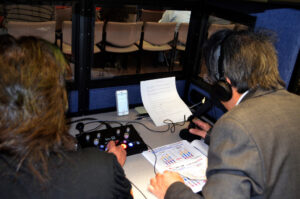
Since the average speech is no longer than approximately 15–20 minutes, this is a good rule of thumb to keep in mind when considering how many interpreters you need for your event. By having two interpreters, they can each switch off interpreting and taking breaks as necessary.
Even when resting from actively interpreting, however, they are still monitoring the original speaker and the interpretation by their colleague and are mentally taking notes (sometimes on paper as well) to insure they are ready to pick back up when it’s their turn.
Call to Action
Planning a multilingual event or conference? Translation Excellence provides professional simultaneous interpreters and complete simultaneous conference interpreting solutions to ensure accuracy, focus, and seamless communication. Contact our team today to discuss your event requirements and deliver a high-quality experience for every participant.
FAQs:
Why do interpreters work in pairs during simultaneous interpretation?
- They work in pairs to avoid mental fatigue and maintain accuracy, rotating every 15–20 minutes to ensure high-quality interpretation.
Why do people need interpreters?
- People need interpreters to communicate accurately when they do not share the same language, especially in professional and critical settings.
What are the advantages of simultaneous interpreting?
- It allows real-time communication without interrupting the speaker, making it ideal for conferences and live events.
What are the three most important skills that an interpreter needs?
- Strong listening skills, advanced language proficiency, and cultural awareness.
____________________________________________________________________
You may also be interested in the following:
Ebook: Top Ten Tips for Interpreters and Translators
Article: Five Things to Remember During Simultaneous Interpretation
Article: Simultaneous Interpretation and the Brain – Which parts of the brain are responsible for the ability to do simultaneous interpretation?
_____________________________________________________________________