



















Closed captioning
Closed captioning services for video everyone can follow
Captions for training videos, webinars, public meetings, marketing, and broadcast. Written and timed by professional captioners, reviewed for accuracy, produced to ADA, Section 508, and WCAG standards, and delivered in the formats your platform needs, including broadcast CEA-608/708 and foreign-language captions.
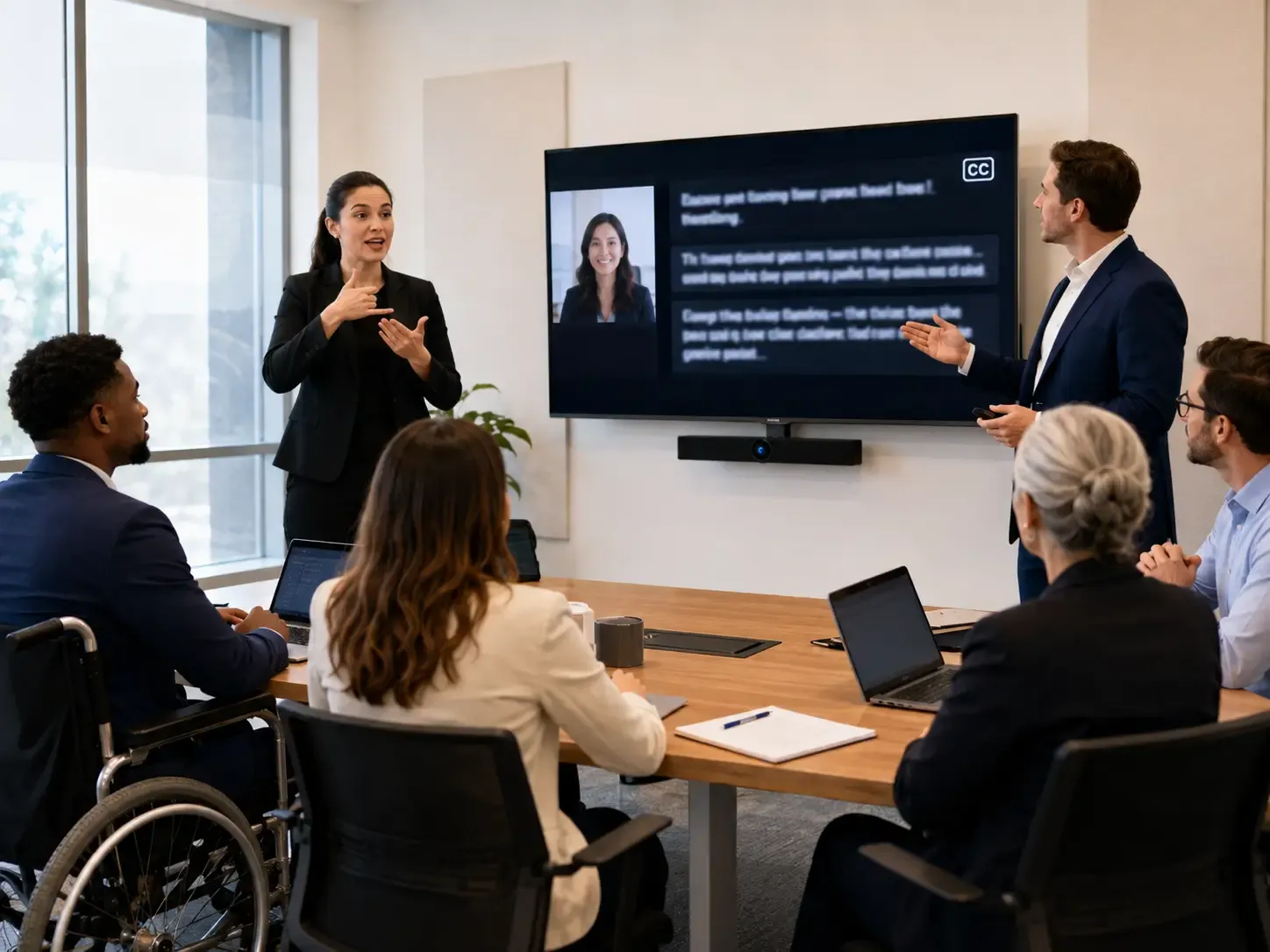
- ADA, Section 508, WCAGCaptions produced to accessibility standards
- Broadcast CEA-608/708Embedded captions for TV and streaming
- Every major file formatSRT, WebVTT, SCC, DFXP, and burned-in
- Foreign-language captionsSpanish and other languages, by professional linguists
Caption types
Closed captions, open captions, subtitles, or CART: which do you need?
They solve different problems. Most organizations need more than one, and we provide all four.
-
Closed captions
Viewers turn them on or off. They include dialogue, speaker IDs, and meaningful sounds, for viewers who are Deaf or hard of hearing.
Best forRecorded video on your website, LMS, streaming, or broadcast
-
Open captions
Burned into the picture, so they are always visible and play on any screen, including social feeds and lobby displays.
Best forSocial video, kiosks, and players without caption support
-
Subtitles
A translation of the dialogue for viewers who hear the audio but don’t speak the language.
Best forReaching audiences in other languages
See subtitling and dubbing -
Live CART captions
A captioner writes in real time while the event happens, on site or on your meeting platform.
Best forLive meetings, events, hearings, and classes
See CART captioning
Caption quality
What compliant captions actually include
Automatic captions miss names, drop sounds, and drift out of sync. Accessibility reviewers check for four things, and every file we deliver meets them.
- AccurateEvery word as spoken, with correct spelling of names and terms. Your glossary and speaker list are loaded first.
- SynchronizedEach caption appears with the speech it represents and stays on screen long enough to read.
- CompleteDialogue from start to finish, plus speaker IDs and sounds that matter, such as [applause] or [alarm sounding].
- Well placedMoved off on-screen text, names, and graphics, so captions never cover what the viewer needs to see.
our new safety procedure starts on monday
[Speaker 2] Our new safety procedure starts on Monday. [door closes]
Compliance
Built for the standards you’re measured against
Agencies, universities, and employers caption video to meet these requirements. We produce captions to the standard you name.
- ADA
- Effective communication for people who are Deaf or hard of hearing. The 2024 Title II rule adopts WCAG 2.1 AA for state and local government web content.
- Section 508
- Federal agencies and their contractors must caption video they publish, under WCAG 2.0 AA.
- WCAG 2.1
- Success criterion 1.2.2 requires captions for prerecorded video; 1.2.4 covers live video at level AA.
- FCC and CEA-608/708
- Broadcast caption quality standards, and embedded caption formats for television and IP delivery.
Our process
From your video to captions on every screen
People write and review every caption. Your delivery date is confirmed with your quote, and rush delivery is available.
- 1Send your videoUpload files or share links, with any script, glossary, or speaker names you have.
- 2Captioned by peopleA professional captioner transcribes and times every caption, with speaker IDs and sound cues.
- 3Reviewed for qualityA second reviewer checks accuracy, timing, and placement against the video.
- 4Delivered in your formatsCaption files for your platform, or embedded and burned-in versions, plus a transcript on request.
Formats
Delivered in the format your platform needs
Tell us where the video will play. We deliver the files that work there, and as many versions as you need.
- SRTYouTube, Vimeo, social, and most players
- WebVTTHTML5 players and learning platforms
- SCCBroadcast and professional video workflows
- CEA-608/708Embedded captions for television and streaming
- DFXP / TTMLEnterprise video platforms and streaming services
- Burned-inOpen captions rendered into the video file
Captions in other languages. Professional linguists translate and time captions in Spanish and other languages, so the same video is accessible to Deaf and hard-of-hearing viewers who read another language. For audiences who hear the audio, see our subtitling and dubbing services.
Client results
Trusted with video that has to reach everyone
Federal agencies and media companies rely on us to make their video accessible.
-
 Energy and environment
U.S. Department of Energy
We provided comprehensive American Sign Language (ASL) interpretation services, both on-site and remotely. Read the case study -
 Entertainment and media
U.S. news network
We subtitled a six-episode documentary series into Spanish and Brazilian Portuguese, built to the platform’s timed-text specification and delivered a week before the international… Read the case study -
 Entertainment and media
Documentary production company
We transcribed and translated Spanish and Arabic interviews and delivered English, Spanish, and French subtitles a week before the film’s premiere. Read the case study
Related services
Often requested with closed captioning
One team, one point of contact. Add any of these to your project.
FAQ
Closed captioning questions, answered
Don’t see your question? A language specialist can answer it in one call.
Talk to a specialist
Get a straight answer
Tell us what you need translated or interpreted, and we’ll scope it with you.
Meet one-on-one with a language services expert, at a time that suits you.
What is the difference between closed captions and subtitles?
Closed captions are written for viewers who are Deaf or hard of hearing. They include the dialogue plus speaker IDs and meaningful sounds, and viewers can turn them on or off. Subtitles translate the dialogue for viewers who can hear the audio but don’t speak the language. Many organizations need both.
Are automatic captions enough for accessibility compliance?
Usually not. Accessibility standards such as WCAG expect captions that are accurate, synchronized, and complete, including speaker IDs and sounds. Automatic captions often misspell names and terms, skip sounds, and drift out of sync. For video you publish, professionally produced captions are the reliable way to meet the standard.
What do ADA and Section 508 require for video?
Section 508 requires federal agencies and their contractors to caption the video they publish, under WCAG 2.0 AA. Under the ADA, organizations must communicate effectively with people who are Deaf or hard of hearing, and the 2024 Title II rule adopts WCAG 2.1 AA for state and local government web content. Tell us the standard you are measured against, and we will produce captions to it.
Which caption file formats do you deliver?
SRT, WebVTT, SCC, DFXP and TTML, embedded CEA-608/708 captions for broadcast and streaming, and open captions burned into the video. We deliver as many formats as you need, ready for YouTube, Vimeo, learning platforms, enterprise video platforms, and broadcast workflows.
Do you provide broadcast captions?
Yes. We produce CEA-608/708 captions and SCC files for television and IP delivery, with caption placement that keeps on-screen text and graphics visible.
Can you caption video in languages other than English?
Yes. Professional linguists produce and time captions in Spanish and other languages, so viewers who are Deaf or hard of hearing can follow in the language they read. If your audience can hear the audio but speaks another language, translated subtitles or dubbing may be the better fit.
Can you caption live events and meetings?
Yes, with CART captioning. A professional captioner writes in real time on site or on your meeting platform, and you receive a transcript afterward. See our CART captioning services for details.
How long does closed captioning take?
Turnaround depends on the total video length, the audio quality, the language, and the formats you need. We confirm a delivery date with your quote, deliver large libraries in batches, and offer rush delivery on request.
How is closed captioning priced?
Captioning is priced per minute of video. The rate depends on audio quality, the number of speakers, the language, the formats, and turnaround. Send a sample or a description of your video library, and we will give you a fixed quote before work begins.
How do you keep unreleased or confidential video secure?
Video is handled under our ISO/IEC 27001 certified information security management system. Files move through secure transfer, access is limited to the people working on your project, and everyone involved is bound by confidentiality agreements.
Tell us what’s at stake. We’ll show you how we’d handle it.
Send your files or describe your event. A language specialist replies with a fixed quote and a delivery date, with no obligation.
Prefer to call? 720-325-0459